

Top 20 SAP FICO Interview Questions and Answers 2025
With a view to career growth in enterprise management, professionals need to prepare for finance-related ERP interviews. Moreover, candidates often search for well-structured SAP FICO Interview Questions and Answers to strengthen conceptual clarity and build confidence. This guide therefore helps readers acquire complete knowledge about the financial accounting and controlling structure of SAP. By transitioning through each concept step by step, beginners and experienced professionals can gain clarity, accuracy, and industry-level knowledge. For those learners who would like structured training with practical exposure, it is recommended to visit the website of FutureLabs Technology Training Center.
Table of Contents
- Introduction
-
Understanding SAP FICO
-
Top 20 SAP FICO Interview Questions and Answers 2025
-
Basic-Level Questions
-
Intermediate-Level Questions
-
Advanced-Level Questions
-
Expert-Level Questions
-
-
Real-World Applications
-
Conclusion
-
FAQs
Understanding SAP FICO
SAP FICO has been known to integrate financial transactions, cost management activities, reporting, and internal controls in one ERP environment. Consequently, it serves as the backbone of the entire financial operation and helps in informed decision-making. Since organizations deal with complex transactions day in and day out, this module has therefore found applications across different industries. Moving deeper into the topic, the following sections highlight the most asked and highly relevant interview questions, which reflect both conceptual understanding and real-time usage.
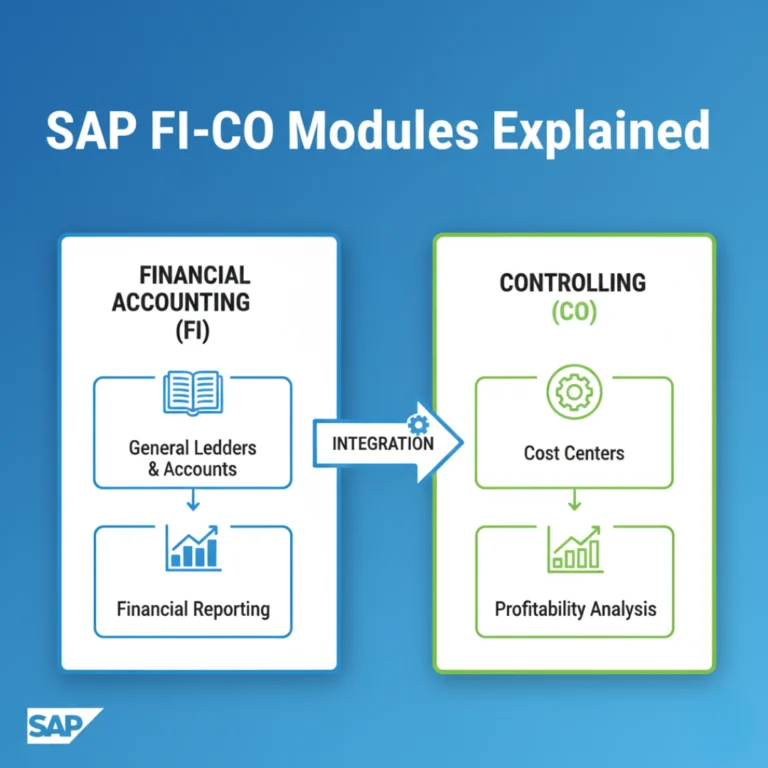
Basic-Level Questions
What is SAP FICO? Explain its components.
It is a combination of two major components:
• Financial Accounting, FI (for external reporting, balance sheets, and statutory compliance)
• Controlling (CO) for internal cost tracking, budget planning, and performance evaluation.
The combination ensures the accuracy of recording financial transactions, thereby managing cost flows.
How does this module integrate with other SAP modules?
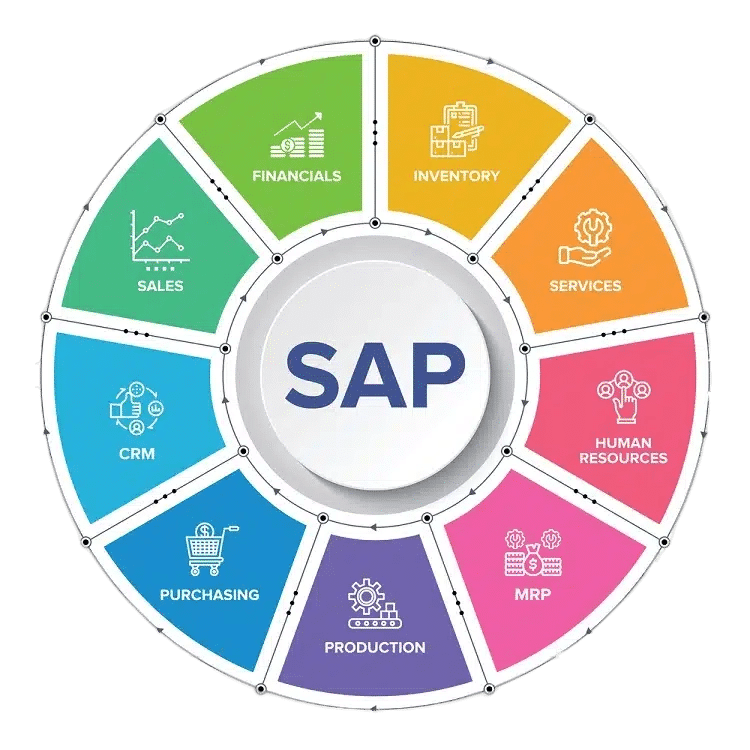
It integrates well with material management, sales, production planning, and human resources. Each transaction, as recorded in one module, automatically posts the financial effect in the accounting structure. This integration provides a seamless business process.
What are the different types of ledgers used?
Organizations typically utilize:
• General Ledger for recording comprehensive financial information.
• Subledgers for category-wise details such as payables and receivables.
• Special Purpose Ledger for customized financial reporting.
These ledgers enhance transparency and control over accounting functions.
What is the purpose of a company code?
A company code stands for an independent legal entity. All financial statements, reporting cycles, and accounting processes are done at this level.
Intermediate-Level Questions
Difference between General Ledger and Accounts Payable
General Ledger centralizes all accounting records, including assets and liabilities, while Accounts Payable focuses only on vendor-related transactions. Both account types work together to keep the financial books balanced.
What is a profit center, and how is it used?
A profit center captures revenue and expenses for a specific business segment. Enables teams to review profitability based on unit, region, or product line.
Role of cost centres
The cost center helps to track all expenses across departments. They support internal budgeting, financial planning, and overall cost monitoring.
Integration with Material Management
During procurement activities, material movements and their values are automatically passed on to the financial module. Ensures correct valuation of purchases and inventories.
Advanced-Level Questions
What is the Month-End Close Process?
By month-end closing, one means balance reconciliation, posting of journal entries, clearing open items, updating asset depreciation, and finalizing the statements. The process ensures that financial reports remain accurate and audit-ready.
Key Steps for Fiscal Year Configuration
Configuration includes defining the fiscal year variant and assigning it to company codes, as well as setting the posting period. This all controls how and when entries of a financial nature are posted.
Multi-currency environment handling
Multi-currency management: assign the type of currency, set up exchange rates, and perform valuation adjustments when the currency fluctuates.
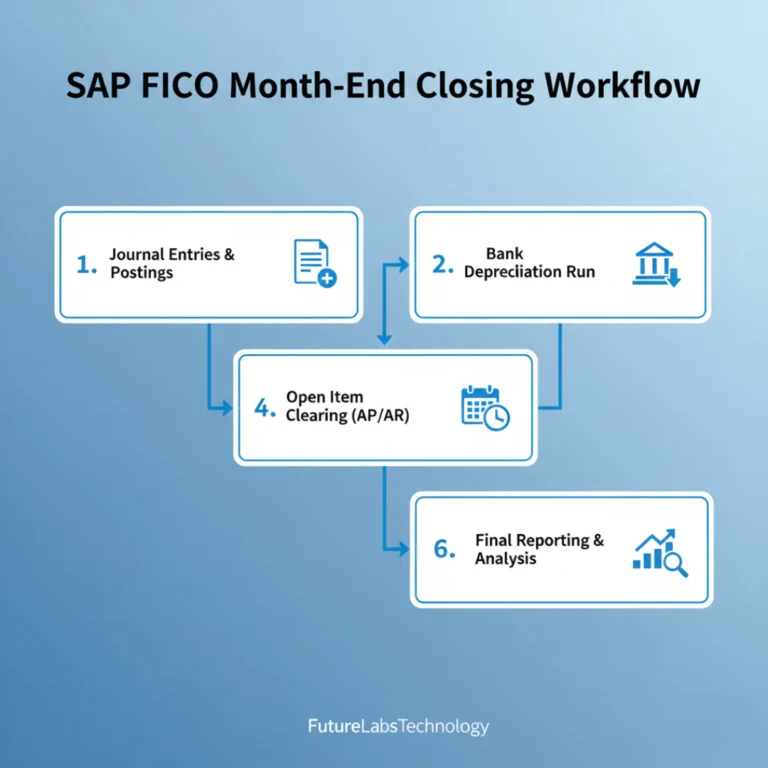
What is a depreciation run?
A depreciation run automatically calculates the periodic decrease in value of an asset. Ensures accuracy in asset accounting and financial reporting.
Expert-level Questions
What is a settlement rule?
A settlement rule defines how internal project or order-related costs are reallocated to appropriate cost objects. Facilitates transparent reporting and reliable budgeting.
How is a financial statement version created?
Statement version is generated by defining reporting groups for assets, liabilities, income, and expenses. This allows tailored reporting to satisfy the needs of business requirements.
Difference between Internal Orders and Cost Centers
An internal order accounts for task-related costs, whereas a cost center represents the ongoing department-level expenses. Both assist firms in judging budget utilization and actual performance.
How are intercompany transactions managed?
Intercompany postings are taken care of by assigning special accounts for accuracy in recording between two or more legal entities. Consolidation adjustments further eliminate duplicate entries.
Real-world applications
Professionals frequently use the module to manage asset accounting, cost analysis, intercompany billing, budgeting, and compliance reporting. Moreover, for more detailed training, refer to this detailed skill development resource on Medium, which explains how structured training shapes long-term career growth. In addition, learners who aim to reach professional mastery can also start advanced ERP programs at the FutureLabs Technology Home Page, where they can gain a wide range of real-time project exposure and placement-focused training. Therefore, building these skills systematically ensures a strong foundation for career advancement.
Conclusion
Financial accounting and cost-control concepts are mastered only through continuous practice and exposure to various real-life cases. Therefore, going through the above-mentioned SAP FICO interview questions and answers will help candidates gain the clarity and confidence necessary for strong performance in interviews. As business environments continue to evolve, companies increasingly seek a balance between analytical skills, system configuration, and hands-on experience. Consequently, guided learning, expert mentorship, and solving real-world problems form a core part of the training programs available on the official website of FutureLabs, which in turn go a long way in strengthening profiles and enhancing career prospects for learners.
FAQs
- Is it difficult for beginners to learn SAP FICO?
It becomes easier if learning is structured and practice is regular. -
Which sectors mostly use this module?
It finds applications in manufacturing, IT services, retail, logistics, healthcare, and banking. -
How long does it take to prepare for interviews?
Usually 4–8 weeks, depending on the learner’s background. -
Does it require hands-on projects to learn it?
Hands-on projects build confidence and practical knowledge. -
Where can learners find complete training with practical exposure?
Learners can access the programs in detail at the FutureLabs Technology Home Page.
This excellent website certainly has aall of the information and facts I needed about his subject and didn’t kno who to ask. https://menbehealth.Wordpress.com/
Thanks for your posting on this web site. From my experience, often times softening up a photograph might provide the photography with a little an imaginative flare. Often however, the soft blur isn’t what precisely you had in mind and can quite often spoil a normally good picture, especially if you thinking about enlarging it.