Why Public Cloud Matters in 2025
What is Public Cloud?
The public cloud has become the fastest-growing part of modern IT systems. As companies move from old on-premise setups to scalable and cost-friendly cloud platforms, the public cloud stands out as the easiest and most powerful option. Whether you’re a startup building your first app or a large business upgrading old systems, a smooth public cloud setup can improve performance, security, and ROI. This article shares what the public cloud is, why it matters, and the simple steps to use it in real business setups—making it clear Why Public Cloud Matters in 2025. To learn more about cloud training and IT skills, you can also explore our SAP courses, IT certification programs, or technology blogs on our website.
Table of Contents
Why Public Cloud Matters in 2025
What is Public Cloud?
Key Features of Public Cloud
Why Businesses Choose Public Cloud
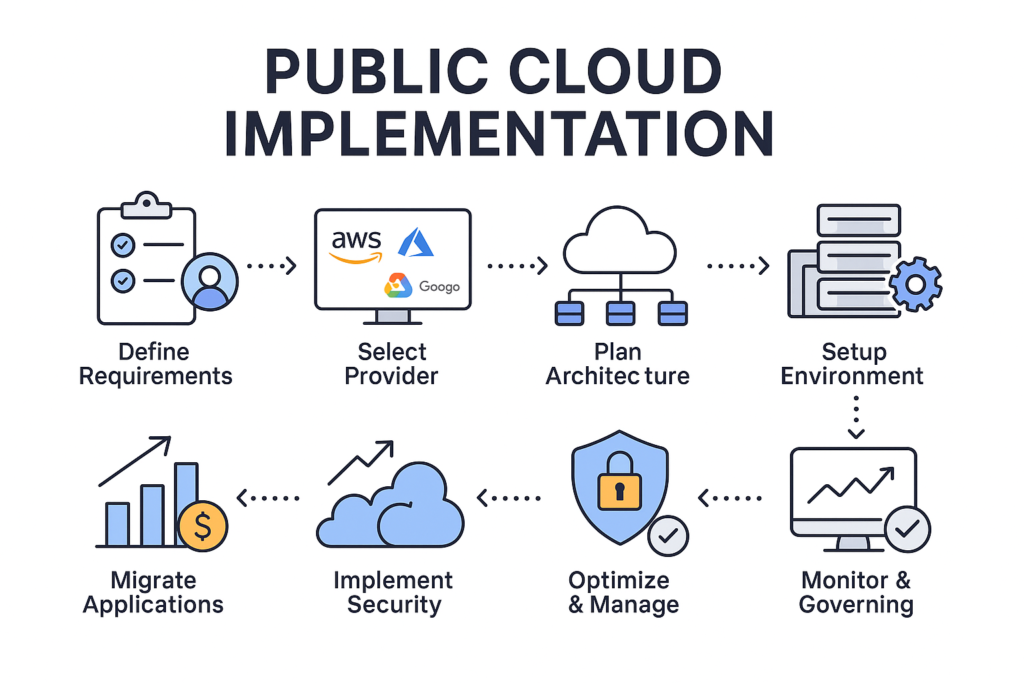
How to Implement Public Cloud (Step-by-Step Guide)
A public cloud is a computing model where resources such as servers, storage, databases, and software are delivered over the internet by third-party providers.
The most popular public cloud platforms include:
Key Features of Public Cloud
✔ On-Demand Scalability
Scale resources instantly without physical hardware.
✔ Pay-as-You-Go Pricing
Pay only for what you use — ideal for startups and enterprises.
✔ High Availability & Global Reach
Deploy applications in multiple regions for low latency and better performance.
✔ Managed Security & Compliance
Cloud providers offer built-in encryption, IAM, firewalls, and compliance standards like SOC2, ISO 27001, and HIPAA.
How to Implement Public Cloud: Step-by-Step Guide.
This is the most important part of the blog — and the most SEO-targeted section.
Below is a complete implementation roadmap to help companies adopt the public cloud successfully.
Step 1: Define Business Requirements
Before deployment, clarify the following: Migration goals
Compliance or data residency needs
Estimated cloud usage
Required applications
Security standards
Budget
SEO Tip: Keywords like “public cloud implementation checklist” and “cloud migration steps” help rank this part.
Step 3: Plan Cloud Architecture
A well-designed architecture improves performance and reduces costs.
Key architecture components:
VPC / Virtual Network
Subnets (public & private)
Security Groups / Firewalls
Load Balancers
Identity & Access Management
Storage (S3, Blob, Bucket)
Databases (RDS, SQL, NoSQL)
Follow the Well-Architected Framework from:
AWS
Azure
GCP
Step 6: Implement Security Best Practices
Security is a crucial part of SEO content since Google prioritizes trustworthy sources.
Follow:
IAM least privilege access
Encryption at rest & in transit
Cloud firewalls and WAF
Backup strategy
Routine patching
Step 8: Continuous Monitoring & Governance
Set up:
Alerts
SLAs
Compliance checks
Automation workflows
This ensures smooth cloud operations 24/7.
Amazon Web Services (AWS)
Microsoft Azure
Google Cloud Platform (GCP)
Unlike private cloud, the infrastructure is shared, but the data and workloads remain isolated and secure through virtualization.
Why Businesses Choose Public Cloud
1. Cost Efficiency
No infrastructure investment. Reduced CAPEX. Seamless OPEX management.
2. Rapid Deployment
Launch servers, apps, and workloads within minutes.
3. Flexibility & Innovation
Support for AI, analytics, automation, and DevOps at scale.
4. Disaster Recovery & Backup
Multi-zone and multi-region protection built into the platform.
Step 2: Select the Right Public Cloud Provider
AWS – best for scalability
Azure – best for enterprise integration
GCP – best for analytics and AI
Evaluate each provider based on:
Cost structure
Native tools
Regional availability
Compliance requirements
Step 4: Setup Cloud Environment
1. Create Cloud Accounts
Set up AWS / Azure / GCP accounts with MFA and org hierarchy.
2. Configure IAM Roles and Policies
Follow Zero Trust principle.
3. Create VPC / Network
Define CIDR ranges
Create subnets
Configure NAT, Internet Gateways
4. Configure Monitoring & Logging
Use CloudWatch, Azure Monitor, or GCP Operations.
Step 5: Migrate Applications & Data
You can migrate via:
✔ Lift and Shift
Move servers and applications without major changes.
✔ Refactoring
Modify the application to use cloud-native services (containers, serverless).
✔ Re-Architecting
Fully rebuild for cloud scalability.
Migration tools:
AWS Migration Hub / DMS
Azure Migrate
Google Migrate for Compute Engine
Step 7: Optimization & Cost Management
Use:
AWS Cost Explorer
Azure Cost Management
GCP Billing Reports
Focus on:
Autoscaling
Rightsizing instances
Stopping unused resources
Conclusion
better performance, lower costs, and higher flexibility, the public cloud offers a simple and strong way to achieve these goals. When teams plan correctly and follow the right steps, cloud adoption becomes smooth, secure, and cost-effective. To explore more useful insights beyond this article, you can check detailed industry guidance shared in this IT training and technology guide, which adds extra value for learners and professionals. With strong security, easy scaling, and global reach, the public cloud remains one of the most important choices for any business aiming to grow in 2025.
Lorem ipsum dolor sit amet, consectetur adipiscing elit. Ut elit tellus, luctus nec ullamcorper mattis, pulvinar dapibus leo.
FAQs
- Why is the public cloud important in 2025?
It offers fast, scalable, and cost-effective solutions for all types of businesses. - Is the public cloud safe?
Yes. It provides strong security features like encryption, access control, and compliance standards. - What is the main benefit of public cloud?
The biggest benefit is flexibility, allowing companies to scale and reduce costs easily.